Hazleton North
Following the retreat of the ice from Britain around 10,000 BCE, the territory (still connected to continental Europe by Doggerland) was inhabited by small populations of Mesolithic hunter-gatherers who left little archaeological evidence of their lives. These groups were highly mobile, perhaps only remaining in Britain seasonally, and built neither permanent settlements nor large-scale monuments that have remained to the present day. This changed dramatically with the arrival of Neolithic farming communities around 4,000 BCE. The development of agriculture in the Near East enabled significant population growth and the emergence of increasingly complex societies. The descendants of Anatolian farmers spread across Europe, displacing and assimilating1 the less numerous Mesolithic inhabitants. These farmers brought with them more than just the cultivation of grains and livestock; they introduced new technologies, economic practices, and forms of social organisation. The Neolithic period also saw the rapid appearance of monumental architecture across Britain, signalling a fundamentally different relationship between people, ancestry, and the landscape they inhabited.
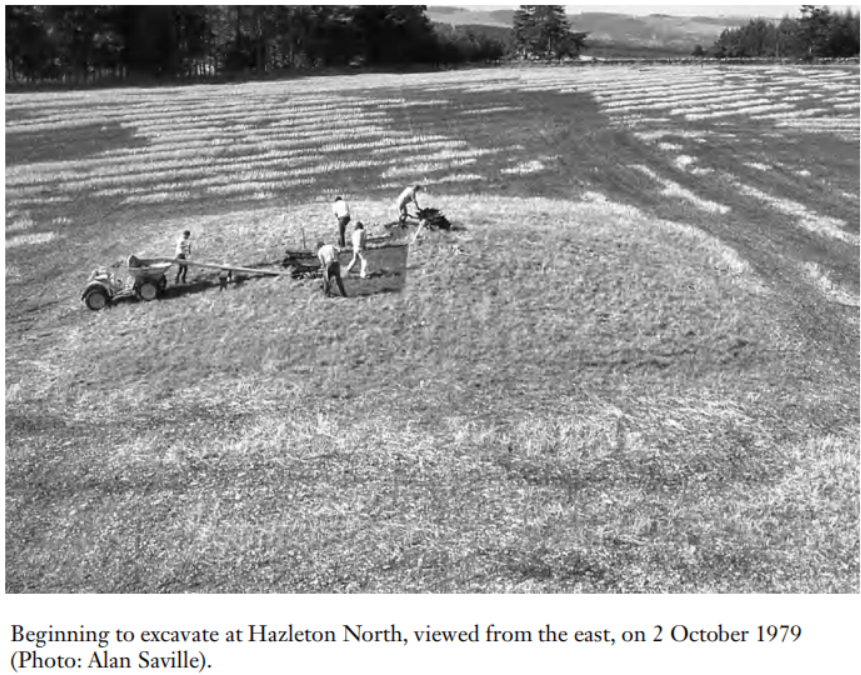
Hazleton North, a Neolithic long barrow situated in the Cotswolds of Gloucestershire, provides an important window into this early farming world. Constructed in the 37th century BCE, scant centuries after the arrival of Anatolian farmers in Britain, it belonged to a tradition of chambered tombs that formed part of a dense ritual landscape containing hundreds of barrows, enclosures, and other ceremonial sites.2 Nothing is particularly special about Hazleton North – today it survives as a low grassy mound. At the time of its construction it would have been a trapezoidal monument, perhaps 60 metres in length and a few metres tall, built to dominate the surrounding landscape. What is remarkable is its state of preservation, how thoroughly it has been excavated, and the glimpse that modern archaeological techniques have permitted us into the social organisation and structure of Britain’s earliest farming communities.
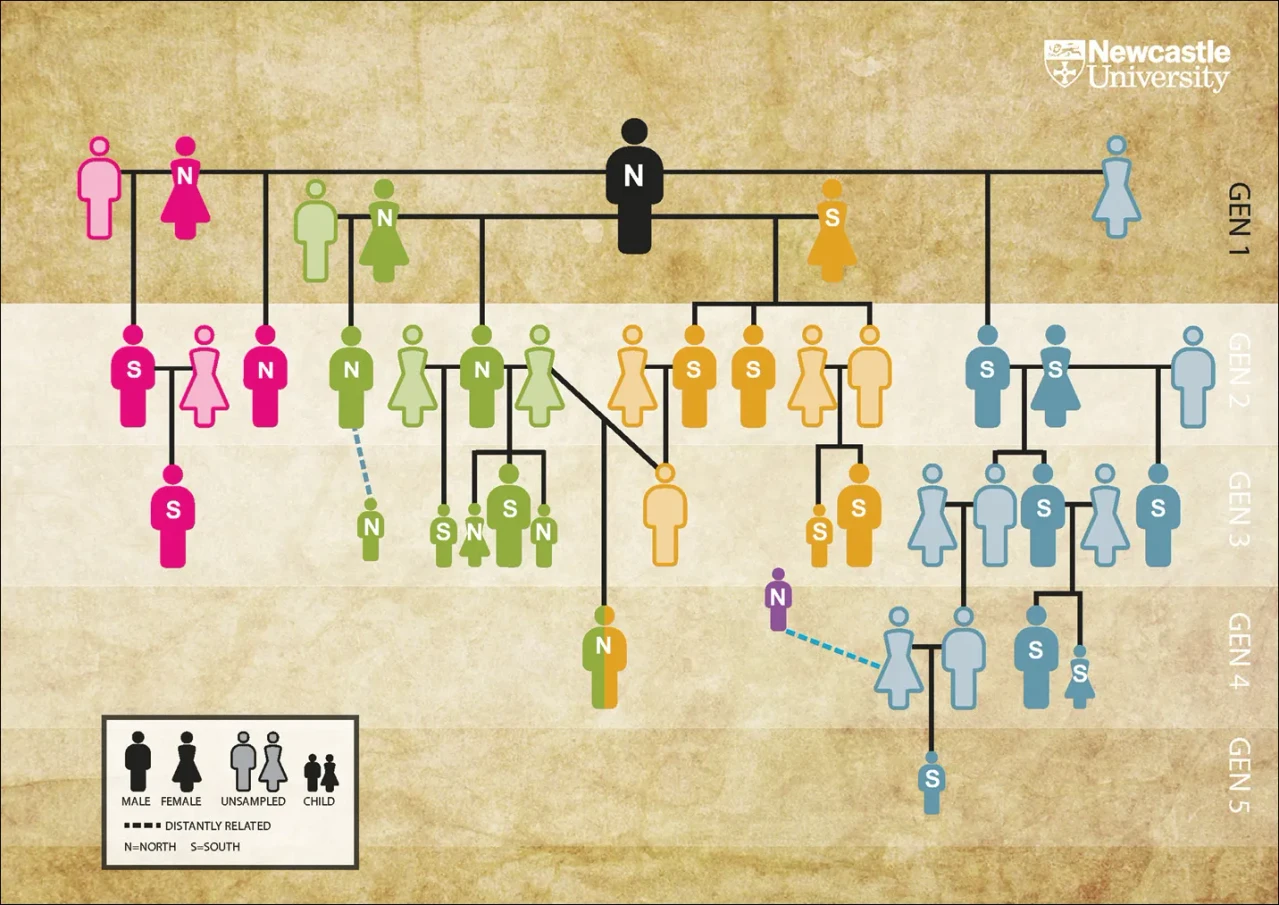
Archaeology has long been adept at reconstructing material culture, but in societies that produced no written records fundamental questions have often been left unanswered. Questions of social organisation have always been the most difficult aspect of prehistoric life to reconstruct. While physical evidence – the distribution of artefacts, arrangements of burials, the forms of monuments – could provide clues, the uncertainty of that evidence allowed for multiple competing interpretations. In recent decades, however, advances in science have allowed us to use DNA analysis to concretely reconstruct biological relationships between Neolithic individuals, shedding new light on debates that had become stale and circular. Hazleton North is one of the most significant case studies in this emerging field. Careful study of the barrow’s remains has revealed the world’s oldest family tree: 35 human beings over 5 generations, placed in specific biological and social relation to each other. Early Neolithic burial monuments were not just communal tombs, but appear to have been highly structured spaces that physically encoded new concepts of lineage, inheritance, and social organisation.
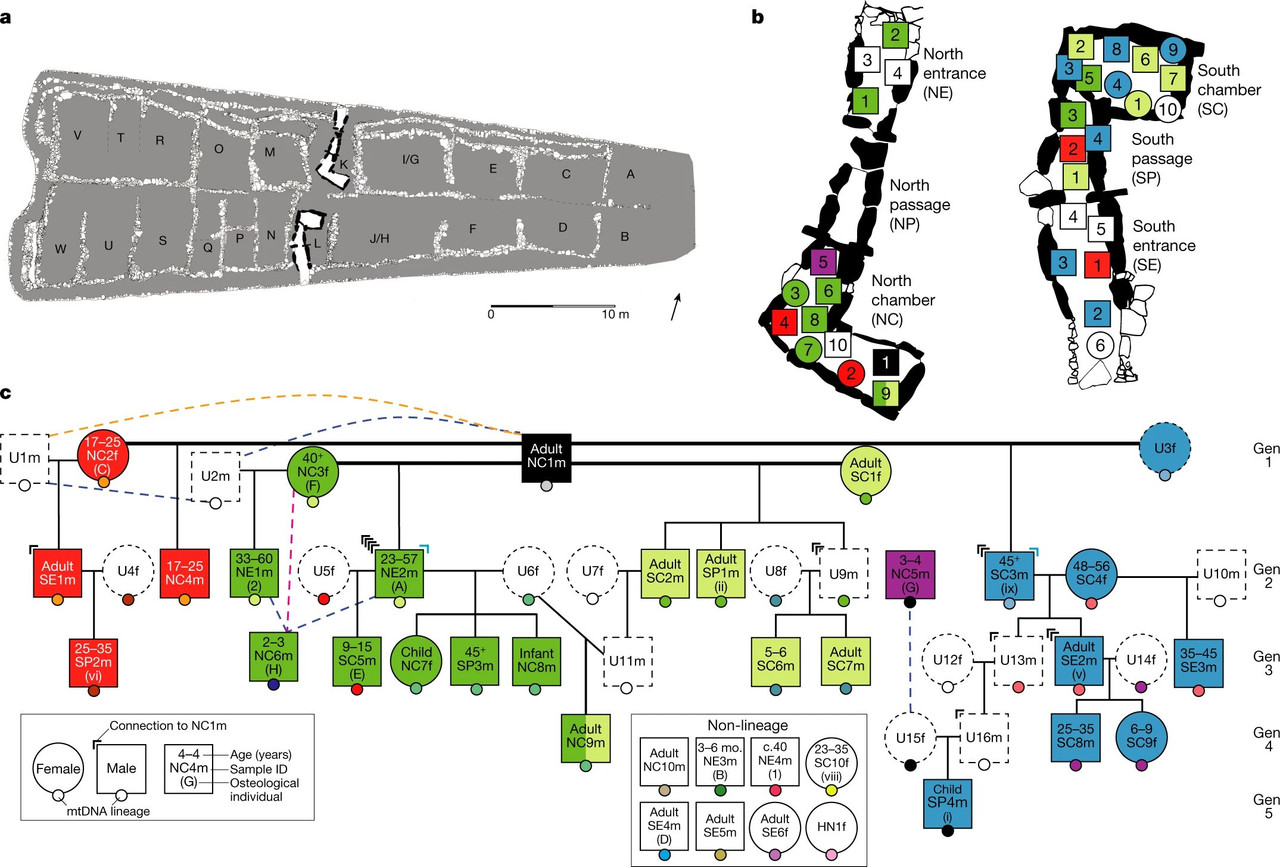
Genetic analysis shows that the majority of the individuals buried within the barrow could be traced back to a single male ancestor. Women who married into this lineage were present within the tomb, whilst daughters of the group were almost entirely absent, suggesting that they left the community upon marriage. This pattern points towards both patrilineal descent, in which identity and inheritance pass through the male line, and patrilocal residence, in which men remained attached to local communities whilst women moved between them. These findings challenge earlier interpretations of long barrows as communal tombs – access appears to have been structured through the lens of kinship and descent, with membership of a particular lineage determining belonging and placement in this shared ancestral space. Rather than representing a broad community, the barrow seems to have commemorated and reinforced specific lineages across multiple generations.
Not every individual buried within the monument could be integrated into the patrilineal genealogy, despite being granted access to the shared ancestral space. This suggests that social belonging in early Neolithic England was not determined solely by biological descent. Membership of a household, adoption, fosterage, marriage alliances, and other forms of social affiliation may have created bonds no less meaningful than genetic relationships. Burial within the barrow implies belonging to a broader and more complex social unit than can be reconstructed through DNA analysis alone. Strontium isotope analysis provides further evidence that these communities were not entirely closed. Several individuals buried within Hazleton North appear to have spent significant portions of their childhood at least 40 miles away from the local area, indicating continued mobility and long-distance connections in this post-hunter-gatherer world. Hazleton North suggests two overlapping forms of kinship: one biological, the other social and expressed through inclusion in the shared community of the living and the dead.
The implications of this extend to the monument itself. Long barrows acted as statements of belonging within a landscape that was being rapidly colonised by farming communities. Mesolithic hunter-gatherers lived transient lives whilst the dead of Neolithic Britain were actively used to transform the landscape, creating concrete links between communities and the places that they lived. It was not just the size of the barrow; it actively structured and displayed relationships between the dead. Different branches of the reconstructed genealogy were placed in different chambers of the tomb, ensuring that Hazleton North functions as a layered record of ancestry. For a society increasingly dependent upon defined territories and long-term occupation of land, barrow tombs helped to stabilise collective identities and legitimise the community’s attachment to the land; our ancestors are here, and so are we.
The most remarkable thing about Hazleton North is the depth of time across which these relationships can be observed.3 We walk over barrows and our ploughs turn up potsherds and flint, but these people left behind no writing, and we know so little of their world. This makes it easy to forget that they, too, were humans. Modern DNA analysis allows the individuals buried within the barrow to appear not as anonymous prehistoric skeletons, but as recognisably human figures embedded within a web of family and community. Even after six millennia, traces of family and memory can still be recovered from the landscape, offering a rare and beautiful glimpse into lives that would otherwise have vanished entirely from history.
-
The exact mechanism of colonisation remains debated, and that is a debate toxified by modern anxieties over migration and population replacement. ↩︎
-
Britain’s iconic stone circles do not appear for several centuries yet. ↩︎
-
And even the 60 centuries between us and Hazleton North is a tiny blip in the million-year long hominid habitation of Britain. ↩︎